
Maths Curriculum
At Wynstream Primary School, our maths curriculum is based on the White Rose Maths scheme to ensure a clear, consistent and progressive approach to teaching and learning. Maths is taught daily and lessons are carefully sequenced so that children develop strong mathematical understanding, confidence and fluency. Alongside this, pupils are supported to explain their thinking clearly and apply their learning through reasoning and problem solving.
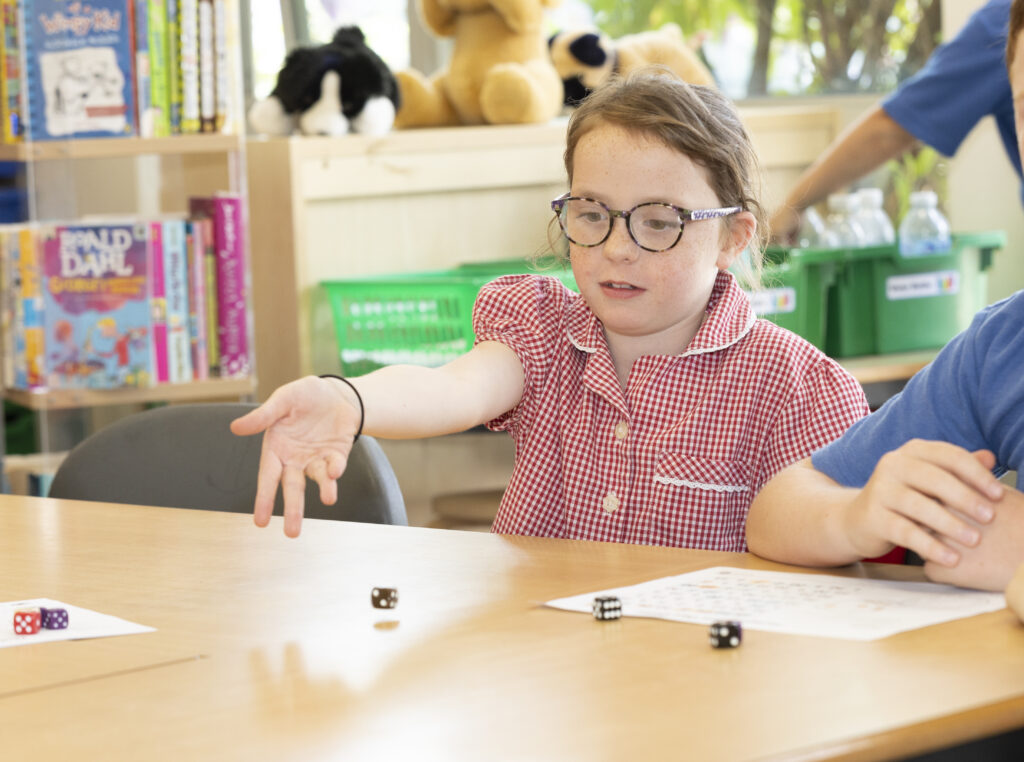
White Rose Maths follows a small steps approach, breaking each unit into manageable lessons that help children build secure knowledge over time. Key concepts are revisited regularly to strengthen understanding and ensure children can make links across different areas of maths. Teaching includes a consistent use of the concrete, pictorial and abstract approach so pupils can represent ideas using practical equipment, visual models and formal written methods.
Calculation strategies are taught in a structured way and children are supported to develop efficient methods for addition, subtraction, multiplication and division. Fluency is strengthened through regular practice, including learning key number facts and times tables. Reasoning and problem solving are embedded across all year groups so children can apply their mathematical skills in a range of contexts, justify their answers and use accurate mathematical vocabulary.
Assessment takes place throughout the year through teacher observation, questioning and ongoing checks of understanding. End-of-unit assessments and periodic summative assessments are also used to identify gaps, provide additional support where needed and ensure all children make progress.
Lessons are adapted to meet the needs of all learners, with scaffolding and resources used to support children who need extra help and challenge provided for pupils who are ready to deepen their understanding.

3 i Statement for Mathematic
White Rose Curriculum
We follow the White Rose curriculum which allows children to learn mathematics effectively, sequencing learning to ensure children build their understanding of number first before progressing though other areas of the maths curriculum. The structure of the learning allows pupils the time to perform simpler tasks before moving on to applying their skills to more complex tasks. Learning is built through a range of small steps, building on previous steps and prior knowledge to develop new skills. Skills are covered once again in later learning e.g. addition and subtraction is used within money, perimeter and capacity along with other areas. The curriculum tries to combine both ‘mastery’ and ‘spiral’ approaches to learning, spending longer on topics to deepen understanding and making connections while repeating learning though revising and reinforcing ideas in different contexts. In the same way, within lessons, fluency, reasoning and problem solving are integrated into every lesson as much as possible to ensure children are given the opportunity to apply their skills.
Teachers use the White Rose PowerPoints and videos to structure their teaching, changing, adapting and adding to the content (and sometimes transferring to Smart Notebook) to ensure the learning is tailored to their class and year group. Where possible, children are given the opportunity to mark their own work to allow them to understand where they have made mistakes and take ownership over their learning. However, misconceptions and misunderstandings are identified by the teacher through reviewing the work completed each lesson to ensure children are given appropriate support to aid their understanding before moving onto new concepts. This may be through interventions, small tutorials or giving additional questions to practise learning or extensions to extend understanding.
Throughout the school, teachers present the subject matter clearly, respond to and adapt their teaching as necessary, following the mastery approach for most children. As far as possible, pupils stay together on the same topic, providing targeted support and additional resources to ensure all are successful. Using this approach, there is little necessity for different levels of work within the classroom except for a small minority who may be working at a level outside their year group. We follow the White Rose progression in calculation methods.
Concrete Resources
Within foundation and key stage one, children have access to a range of resources to help them understand and embed their learning. They are made familiar with the range of physical resources to enable them to select the appropriate tools for the task they are completing with increasing independence. The range of resources available to children in key stage two is expanding to ensure all will have access to a range of resources as soon as possible. Within our curriculum, we use a variety of concrete resources to represent the learning, though the use of resources including but not limited to Base 10, bead strings, place value counters, tens frames and Numicon. These are also used within the White Rose curriculum, with all children approaching problems involving a range of pictorial representations before moving onto abstract concepts. This is to allow children to embed their understanding and grow in confidence, developing an enjoyment of maths.
‘Revisit’ Maths
Morning Maths – Each day, children across the school complete morning maths, gradually adding to their skills and understanding. They follow the consistent routine, developing skills, revisiting previous learning or being introduced to new concepts to ensure they are confident in their understanding and fluency across different areas of maths. Teachers choose the number of questions set but revisit the same style of questioning over a number of days, allowing children the time to apply their understanding with increasing confidence. Arithmetic skills and basic understanding of number will be covered alongside other areas of maths which have been learnt, with some morning maths questions focussing on the learning from the previous day to build confidence before moving onto the next step in a sequence of work.
Flashback 4 – Taken from the White Rose curriculum, these are a daily starter activity used within a lesson, consisting of one question each from a topic covered last lesson, last week, two or three weeks ago and last term or last year.
Spot On With Numbers
Two members of staff working in key stage one are trained to administer the Spot On With Numbers intervention programme with children in years 1 and 2 who have moderate difficulties in maths by accelerating the progress and encouraging them to catch up with their peers. The programme helps create positive attitudes towards maths and allows children to gain confidence and feel successful during their sessions. The learning is organised into 6 topics that focus on key aspects of number: numbers 0-5, numbers 6-10, exploring 10, place value to 20, additive reasoning and multiplicative reasoning.
Times Table Rockstars
Quick and accurate recall of times table and related division facts is fundamental to success in maths lessons. Times Table Rockstars provides pupils with an online, interactive way to learn and practise their times tables, providing instant answers if a child answers questions incorrectly. Alongside this, the programme presents facts which an individual finds tricky more frequently until they have mastered them. TTR provides children with short opportunities to practise their skills, allowing them the choice of 1, 2 or 3 minute games. Children are set appropriate times tables based on their understanding, with new tables steadily introduced over the year. The platform is used both in school and as part of home learning in key stage two, with teachers setting children 20 sessions to complete each week (equating to 20 minutes).
Times Tables Championship
Once children reach upper key stage two and should be able to recall their times tables and related division facts up to 12 x 12, they move onto the school times tables championship. They are tested at least 3 times a week, with each test timed at 3 minutes. This involves a range of levels:
- Individual times tables
- Bronze – all of that times table in order (12 questions).
- Silver – all of that times table out of order with questions showing the commutative properties of multiplication (26 questions).
- Gold – multiplication questions, division questions and missing number questions for the times table (22 questions).
- Olympics – Times tables, division facts, multiplication and division of multiples of 10, missing number problems involving all times tables.
- Grids – Easy in order, Medium mixed on one side and hard mixed on both sides.
- Championship – Exploring a range of mathematical concepts including multiplying and dividing by 10, 100, 1000, percentage of numbers, algebra etc.
Sparx
Sparx has been introduced in key stage 2 to allow children to learn and quickly recall times tables facts through a range of games. The aim of Sparx is to help children become more secure in their times tables and allow them to answer questions within 6 seconds. Children complete an assessment regularly on the platform and this sorts them into an appropriate group/club, setting them target questions to memorise over a period of time. Pupils need to complete 100% of their set task per week and will earn daily tokens each time they log in and complete around 20 questions.
Rewards
On a weekly basis, certificates are presented in celebration assembly to highlight the achievements of children across the school on Sparx and TTR. Within each class, the child who completes the greatest number of sessions in the week earns a TTR certificate. On top of this, those who earn at least 4 daily tokens within a week will receive a Sparx certificate. Teachers have been given optional certificates to present to children in their class when they have completed their Sparx work each week if this motivation will encourage engagement in the platform.
Impact
Through the implementation of maths at Wynstream, our children will demonstrate quick recall of known facts and procedures, including but not limited to number bonds, multiplication and division facts and a range of methods for calculation. Each child will be able to access the curriculum at their year group level except in exceptional circumstances. They will be able to use their maths learning across a range of contexts and problems, reasoning and explaining their thinking, making connections and noticing relationships. Alongside this, they will show resilience when approaching new learning, articulating their understanding as they work through problems. The end points for each academic year will be documented using OTrack, to document teacher assessments and termly NFER/SATs tests.
Subject Summary
Click the links below to download: