
Our Music curriculum enables children to develop confidence, creativity and a lifelong appreciation of music. From Foundation Stage to Year 6, pupils build their knowledge and skills through four key strands: Singing, Performing and Instrumental Skills, Composing, and Listening and Appraising. These strands are carefully sequenced to ensure clear progression across the school.
Singing is at the heart of our curriculum. In the early years, children sing simple songs and rhymes, learning to match pitch and follow a melody. As they move through Key Stage 1 and 2, they develop control, sing with expression and dynamics, and gain confidence performing as part of a group. By upper Key Stage 2, pupils sing in parts and harmony, perform different sections within a piece, and use their voices confidently across all areas of their musical learning.
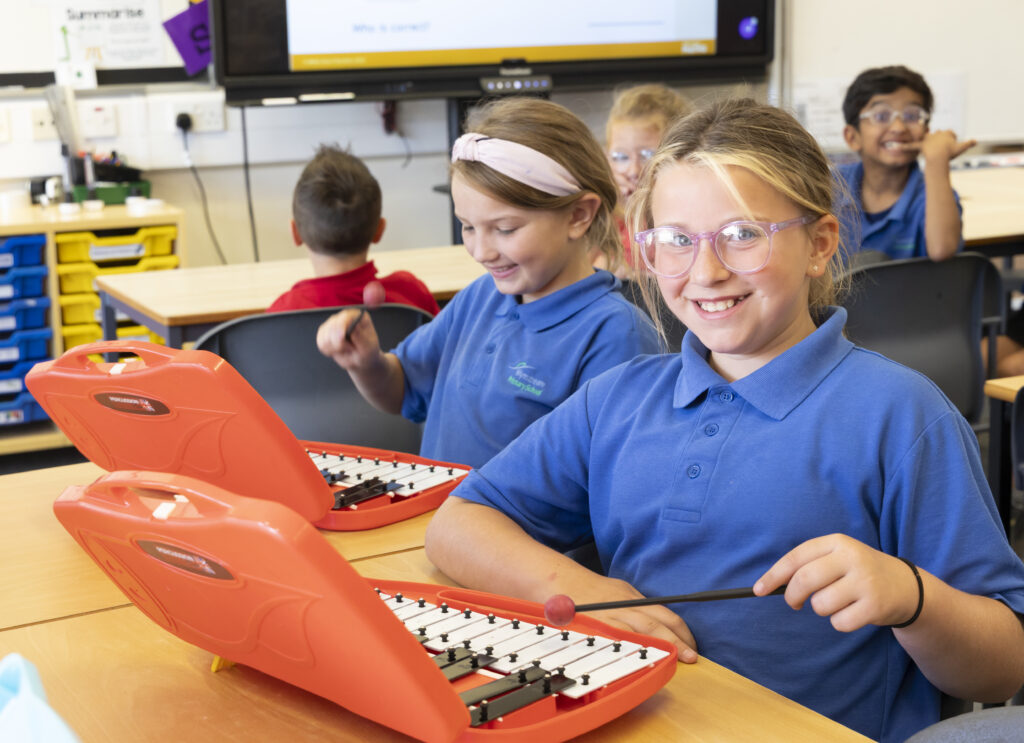
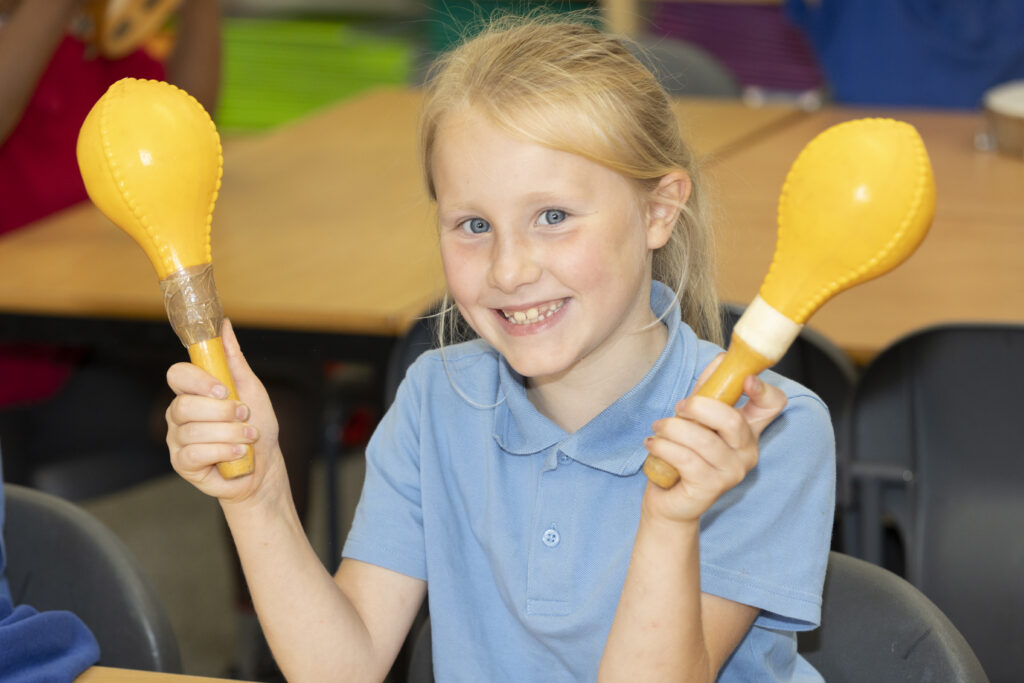
Performing and Instrumental Skills develop through whole-class ensemble teaching and practical music-making. Children begin by learning how to handle instruments correctly and play together as a group. As they progress, they read increasingly complex notation, play in different time signatures, and perform more challenging rhythms and melodies. Pupils experience a wide range of instruments across the school, including percussion, recorder, ukulele and keyboards. By Year 6, they perform confidently both solo and in groups, organise performances independently and demonstrate strong ensemble awareness.
Composing encourages creativity and musical understanding. In the early stages, pupils explore sound and create simple compositions using graphic scores and short rhythmic patterns. As their skills grow, they compose using notation, melody and lyrics, and begin to improvise with increasing control. In upper Key Stage 2, pupils compose confidently using their full range of musical knowledge, refine and improve their work, and use technology such as BandLab to support composition. They learn not only how to create music, but how to evaluate and develop it.
Listening and Appraising develops pupils’ understanding of music from different cultures, periods and styles. Children learn to identify elements such as pitch, tempo, dynamics, timbre and structure, and use appropriate musical vocabulary. They explore music from British traditions and around the world, including Brazilian samba, West African drumming, Indian classical music, jazz and rap. As they move through the school, pupils develop the ability to recognise genres, identify major and minor keys, understand how music has changed over time, and make thoughtful comparisons between styles.
Throughout the curriculum, pupils build secure knowledge of the interrelated dimensions of music — pitch, rhythm, tempo, dynamics, timbre, structure, harmony and melody — applying this understanding in their singing, performing and composing. They also learn about the historical and cultural contexts of music, exploring how technology, society and global influences have shaped musical development.
By the end of Year 6, pupils are confident performers, thoughtful listeners and creative composers who understand music as both an art form and a cultural expression.

3 i Statement
Intent
The principle aim of Wynstream’s Music curriculum is to enable children to understand the interrelated dimensions of music through a repetition-based approach to learning. Children will learn to appreciate and understand a wide range of high-quality live and recorded music drawn from different traditions and from great composers and musicians while also developing an understanding of the history of music. Children apply a set of musical concepts to a variety of different activities to enables more secure, deeper learning as well as the mastery of musical skills. We consider mastery to be both a deeper understanding of musical skills and the acquisition of new ones.
Implementation
At Wynstream, we follow the Charanga Scheme which has 9 Dimensions. These are Pulse, Rhythm, Pitch, Dynamics, Tempo, Timbre, Structure, Texture, Notation.
In their weekly Music lessons, children will gain an understanding of musical concepts through a repetition-based approach to learning. Learning about the same musical concept through different musical activities enables a more secure, deeper learning and mastery of musical skills. Each unit of work comprises the strands of musical learning which correspond with the National Curriculum for music and is divided into three strands: Listen and appraise, musical activities and performing. As pupils progress through the units of work these interrelated dimensions of music are reinforced. With each new song they begin with the foundations of pulse, rhythm then pitch adding new dimensions as they progress. This represents an ever-increasing spiral of musical learning.
The importance of each dimension changes focus as they progress through the school.
In EYFS, pupils will begin to find the pulse and copy a rhythm using voices, body movements and an instrument. In KS1, pupils will continue to develop their understanding of Pulse, Rhythm and Pitch and begin to learn the dimensions of dynamics, tempo, timbre, structure and texture of music. In Lower KS2, pupils will focus equally on the dimensions of pulse, rhythm, pitch, dynamics, tempo, timbre, structure and texture of music. They will be able to talk about how the Pulse, Rhythm and Pitch work together and the musical dimensions featured in songs such as texture, dynamics, tempo, timbre and structure. In Upper KS2, pupils will continue to embed the foundation dimensions of pulse, rhythm and pitch however there is a greater emphasis on the dimensions of dynamics, tempo, timbre, structure, texture and notation. They will be able to talk about how a composition is shaped by the tempo, dynamics, timbre, texture and structure and will be able to use musical notation to perform a simple song.
Impact
The impact of our Music curriculum will be measured by the increase in the quality and consistency of Music teaching and learning across the school. We expect our curriculum to enhance the overall profile of Music in our school and increase pupil engagement with and enthusiasm for, this subject. Pupils should develop an appreciation of music and develop the confidence to explore their creativity through music and singing. Teachers will measure progress against the specific criteria set out for each unit in the Charanga scheme. Subject leaders will routinely observe lessons as well as monitor pupil and teacher voices to ensure that our Music curriculum is having its desired impact.